Good escape rooms feel coherent even when they are trying to fool you.
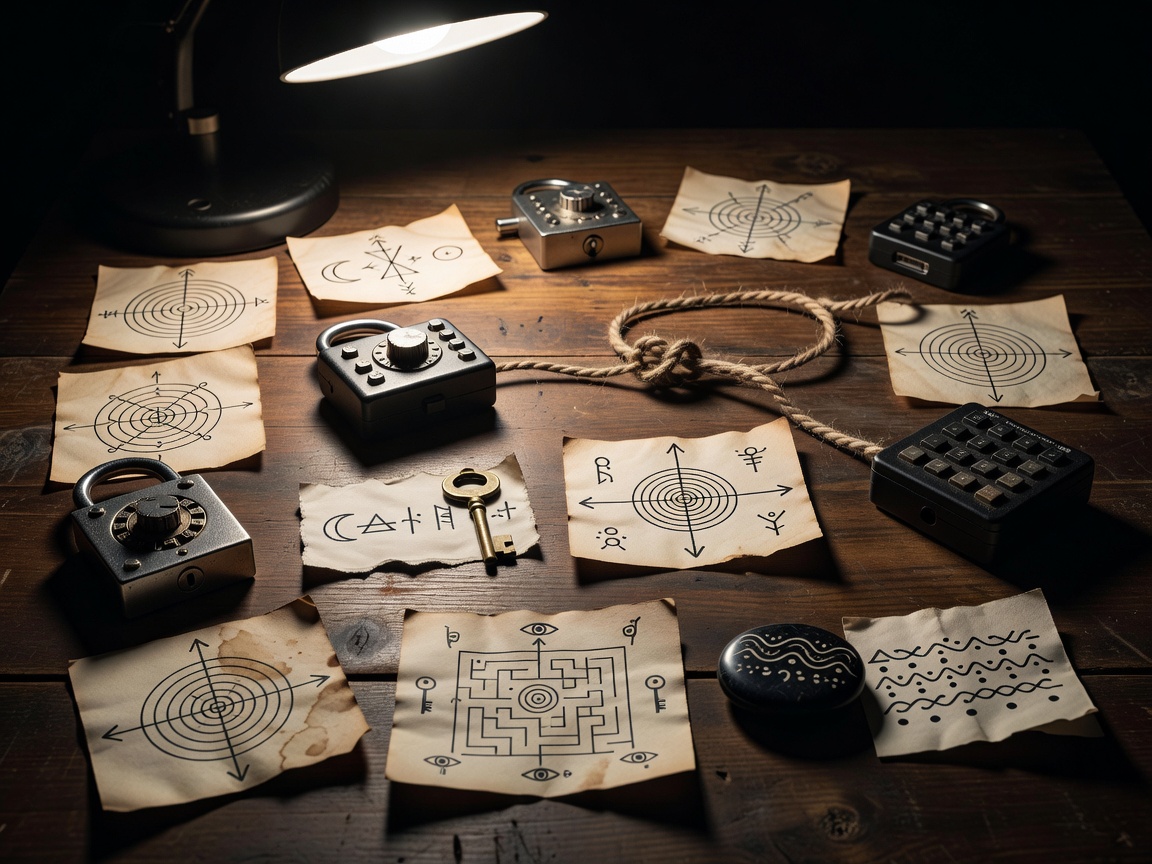
Escape rooms sit in an interesting space between puzzle design and live group dynamics. A crossword or sudoku only has to manage one solver’s attention. A room has to manage several people, moving at different speeds, under time pressure, in a space filled with objects that may or may not matter. That makes design discipline much more important than the themed furniture would suggest.
The first question is structural: does the room run in a linear chain, in parallel branches, or in a hybrid model? A linear room gives one main puzzle at a time, so the whole team converges on the same bottleneck. This keeps the logic clear but can cause idle hands if one clue stalls. A parallel room splits the team across several tasks that later combine. This improves participation, though it also increases the risk that one branch feels thin or disconnected. Many of the most satisfying rooms use a hybrid structure: a few simultaneous tasks early on, then a central synthesis puzzle that gathers the room into one final movement.
Observation puzzles are often the entry layer. A pattern on a wall, an unusual order of books, a sequence of symbols or a hidden compartment can all be fair. The design problem is that search is not the same as reasoning. If progress depends mainly on touching every prop until something clicks, the room starts to behave like a tidy scavenger hunt. Search should uncover information. Logic should interpret it. When those jobs blur, players argue about whether they are being clever or merely thorough.
Red herrings, clue chains and signal control
Red herrings are tricky. A little misdirection can create tension and make a reveal land well. Too much, and the room becomes suspicious of itself. Players stop trusting the environment and start second-guessing everything, which is a drain on momentum. The cleanest rooms use selective distraction rather than chaos. They let irrelevant objects exist as scenery, but they do not constantly mimic puzzle signals with meaningless detail.
Clue chains need the same discipline. One clue should clearly produce a code, a key, a phrase or a next instruction. If a lock accepts four digits, there should be a reason the players know which four and in what order. Ambiguity may be atmospheric; it is rarely elegant. The best rooms teach their own internal language early. Perhaps colours always map to order, or perhaps symbols always refer to one specific chart. Once the convention is learned, later puzzles can become more demanding without feeling unfair.
Physical components complicate this further. Directional magnets, hidden catches, light triggers and sound cues can be delightful, but only when they serve the logic. A mechanical reveal that bypasses reasoning may create a brief thrill and then evaporate. By contrast, a lock opened because the team understood a pattern feels earned. The room’s theatre matters, but its logic is what makes the memory last longer than the costume.
Why teamwork changes puzzle design
Because escape rooms are social, communication is part of the puzzle system. Good rooms support call-and-response play: one player finds symbols, another spots a matching legend, a third notices that the order comes from a nearby map. Parallel paths can make this vivid. They can also produce the opposite effect, where two people solve half a room while others carry keys and look politely occupied. That is not only a hosting issue. It is a design issue. Puzzle bandwidth should match the expected group size.
Hint systems matter here as well. Some venues deliver hints through an in-room character or audio channel, while others use tablets or simple text displays. The mechanism is less important than the timing. A hint that preserves the remaining logic is useful. A hint that gives the answer because the room was under-signposted is really a patch for design weakness.
What to look for when choosing a room
If you enjoy deduction, look for rooms described in terms of puzzle density rather than jump scares or cinematic spectacle. If your group likes participation, hybrid or parallel structures tend to work better than strict linear chains. If novices are joining, avoid designs that rely heavily on obscure physical interactions. Rooms inspired by detective, laboratory or heist themes often suit logic-first groups because the mechanics fit clue interpretation naturally, though theme alone guarantees nothing.
In the end, an escape room succeeds when every solved piece feels like part of one deliberate grammar. The padlocks, props and hidden compartments are only the accent marks. The sentence is logic.